Introduction
Nice motivational headline, right? I promise I’ll explain everything - just bear with me until the end.
Each of us can assess pretty well whether we’re following any rules or not. At least I hope so. But maybe you’re reading this article at a moment when you have no rules at all. Or you have them, but you keep breaking them over and over. And maybe you think you don’t even need them.
I’m writing about this because it took me a very long time to start following any rules myself. And that’s despite the fact that at that point I already had years of experience behind me - working at a commodity hedge fund and then trading on my own account.
I used to tell myself: „I already know enough, I don’t need rules. Those are for the others. Mostly for beginners - that’s exactly the group that desperately needs rules.“
And honestly, I was already tired of all the trading wisdom and rules that the internet is full of. I was in a hurry to trade and I definitely didn’t want to be held back by some rules. I saw my existing experience as a big head start over others.
Soon, however, it became clear that not everything goes as I expected, and nothing is as obvious as it seems.
He who is too clever is foolish again.
What was holding me back was actually the absence of certain rules - something I only realized much later. And the rules I was already using, I was using as an unconscious process, without naming them precisely. Which also isn’t ideal, because what we can’t name, we can’t improve either.
The rules crept into my trading somehow inconspicuously and gradually. Until one day, during a conversation with a friend about how to start trading, I realized I had dumped a whole pile of rules on him. And that’s when the moment came: Aha - I actually do use rules, I just needed to name them precisely. What had been an unconscious process became a conscious one, and that helped me look at the whole thing differently.
We learn things by doing them, and by teaching others to do them.
Because in both moments, we discover new perspectives. When I wanted to explain to my friends how to start, I had to learn to name things and present them clearly. And that was the process of realizing my own experiences - things I had taken so much for granted that I didn’t even notice they had long been part of my trading.
Later, I started actively searching for rules, identifying them, naming them - and I understood that rules are good.
Rules Are Good
I came to the conclusion that rules aren’t there to tie us up. On the contrary - they should help us stay on a certain course and in a certain mindset on our way toward something. So we don’t run around left and right, or even worse - backwards.
And this applies at every level of life, not just in trading. I often have to remind myself of this.
Want to lose weight? Right away there are x rules: I avoid large amounts of carbs, fruit only in the morning, nothing to eat after 6 PM, one cheating day per week... Everyone does whatever works for them.
So why would it be any different in trading?
A cheating day during a diet? Well, breaking the rules can sometimes actually be beneficial - for various reasons. And this applies just as much in trading as in anything else.
Breaking the Rules
If you’ve seen the movie I, Robot with Will Smith, you might remember the conversation between Spooner and Dr. Calvin:
Laws are made to be broken.
Isn’t it the same with rules? Some people, however, take this too literally.
The world is changing, the market is changing, we are changing. And what we have to learn is how to respond to these changes correctly. But what does it actually mean to respond correctly? How do I know when to react and how to react?
Many will break the rules simply because they can’t properly assess when the right moment to break a rule actually is - if that moment ever comes at all.
First of all, in order to break some rules, I first need to have some. And when and how to break them - only experience can teach us.
Because in order to break, change, or even gently bend the rules, we need to know significantly enough about the subject. But do we?
That’s why we need to be very careful about breaking rules. So that it doesn’t end up exactly the way the title of this article says.
If you’re a beginner, just add a rule zero right at the start: Follow the rules without exception.
Jason Statham in the movie The Transporter also had his own rules. And breaking them led to problems that had to be solved afterwards. And he was a professional - not a beginner. So let’s not try it either.
So what could such rules look like? For my trading, the following 11 rules make sense. I hope some of them will make sense to you as well - or at least inspire you. And why 11, and not 10 or 15? I simply didn’t want to be tied down by a round number, and I kept as many rules as I felt were appropriate.
So here they are:
The 11 Rules
1. Do not trade without a plan
Let’s not enter a trade when we don’t know in advance where we’ll exit. A trading plan should include where to enter the trade, but most importantly where to exit it. And it should be based on our backtesting and/or market observation.
The plan, of course, also includes risk and money management. I sometimes call this rule 3E - Enter, Exit, Escape. Yes, escape is also part of the plan. Don’t laugh - I’m serious. I know myself - sometimes it’s just better to run away from the market than to force my way into it.
After all, there's a very similar rule in chess. When your opponent attacks your king with check, you follow the CPR rule. What does it mean? Capture – take the piece that's threatening you. Protect – block the check with one of your own pieces. And the last option, Run away – simply move your king out of danger. And it's precisely this last move that is sometimes the best one. It's the same in trading – sometimes the best decision is to simply walk away from the market and not trade at all.
2. Risk no more than you can afford to lose - and risk enough so that a winning trade is meaningful
(Ed Seykota)
This is my favorite rule. And that’s despite the fact that it sounds so obvious - in the beginning I struggled with the question of how big a position to actually open.
The rule says we should open a position we feel comfortable with, first and foremost. Not too big that during its lifetime I sit on the toilet with cramps in my stomach - but not too small either, so that we don’t end up not caring how it ends. And this is a strongly individual matter.
An open position should keep us in a gentle tension. The kind where we can still make rational decisions. Just the right amount of alertness.
Many traders have the problem that their accounts are undercapitalized and they take on unnecessarily large risks. Such accounts usually have a short lifespan. But that’s another story.
3. Be willing to lose and cut your losses
This is an essential part of trading - losses. Even the best traders don’t have a 100% win rate. This is simply a fact and we have to accept it.
The loss should be predetermined. In practice, this means we must always set a Stop Loss.
Let’s not focus on profit and not chase it blindly - let’s manage our losses instead. Once a position reaches its loss level, close it and focus on other potentially profitable trades.
Let’s not waste our energy (including the emotional kind) on losing trades. Instead of trying to prove we’re right in the market, let’s earn money trading.
And most importantly - never add to a losing position.
(Those of you who know my Trade Manager 4 Pro know that yes - it does allow adding to losing positions... But more on that another time.)
4. Don’t hurry to take your profits
(Jesse Livermore)
In the early days of my trading, many years ago, points 3 and 4 were a problem for me. As soon as a position got into profit, I rushed to close it.
I felt emotional tension with every market movement and I was afraid the position would end up at a loss, so I’d rather take even a few cents of profit. On the other hand, I was able to stare desperately for two days at a losing trade that didn’t want to come back. That had nothing to do with trading - it was just hoping. And desperate hoping at that.
If the market is moving in our direction, it’s better to keep the position open and just protect it from a full or partial loss with a Trailing Stop Loss.
5. Don’t try to predetermine your profits
This rule follows from the previous one. When we tell ourselves in advance „I’ll exit at +50 pips,“ very often the market moves 200 and we just watch our profit run away. The market doesn’t know where we set our target. Let it go wherever it wants - we just react.
6. Don’t get greedy
Greed is an emotion, and in trading it is far worse than fear. While fear sometimes holds us back unnecessarily, greed drives us forward. And it’s one of the main reasons trading accounts get blown up.
In trading, it’s better to focus on the process - on becoming a good trader - than to get emotionally lured by the idea of getting rich overnight. Nothing like that works. And when it does, it’s something like winning the lottery.
First of all, our account must survive. When we’re greedy, we don’t give it a chance. And we don’t give ourselves one either.
7. Never be emotional
The goal is to reach a point in your trading where neither losses nor profits can throw you off balance. If you reach this point, your strategy is set up correctly and you can make more rational decisions even in critical moments - which will inevitably come.
The market is not a place where you should vent your sadness, resentment, or anger. When you’re in a strong emotional state that could negatively affect your decision-making, simply don’t trade.
8. Be patient
Big market movements take time to develop. And we need time to become better traders.
The market does not tend to reward the impatient. Those who can’t wait for their setup, who get spooked out of a position at the first retracement, or who enter before the market confirms their thesis. Patience isn’t passivity - it’s actively waiting for the moment that fits our strategy.
9. Do not trade when you don’t feel well
The moment you feel you’re not in a good place, don’t trade. It can unnecessarily lead to mistakes and losses - and those certainly won’t help your wellbeing.
If you have a lot of these moments - whether stressful situations at work, in the family, or you’re sick - try to think about whether your strategy could be summarized into a few simple rules that an automated trading software could follow. You just need to oversee it correctly, and it can take trading opportunities even when you’re not okay.
10. Avoid overtrading
Sometimes nothing is happening in the market and there are no opportunities that fit our strategy. That’s when we tend to look for opportunities elsewhere. Which in itself isn’t bad - but it often slips into us opening positions out of boredom that we haven’t tested.
Set aside a few hours a day to dedicate to trading. It’s not true that the more I trade, the more I’ll earn. Often the opposite is true - less is more.
And the other side of the coin applies too: don’t open too many positions at once so that your attention doesn’t get too scattered. Watching a few positions is much easier than watching many.
11. Money cannot be made every day
This is an extension of points 5 and 6 - it just names what wasn’t explicitly mentioned there.
And even when someone is a professional trader making a living from trading, they know it’s not a job where you get paid every day. There are days and there are days. Sometimes the best trade of the day is the one we didn’t take.
Conclusion
Rules are good. And even if it doesn’t seem like it, you’re certainly already following some - even if unconsciously. They help us stay in a mindset and direction that makes sense to us. But we shouldn’t follow them blindly and unconditionally.
Each of us should find our own. The ones that we feel are helping us move forward. The ones that guard our weaknesses - and those need to be identified in trading as early as possible.
When we find out we’ve adopted a bad rule, let’s simply throw it out and replace it with a new one. Let’s keep learning from the experiences and mistakes of others, but also from our own.
Maybe after some time, after years, we’ll find out we’ve started using the rules we threw away years ago. But that’s part of the process on the path to becoming a better trader. Maybe that day we just matured into that rule. And maybe today we matured into the decision to follow any rules at all.
The problem is, each of us is different. My rules may not be suitable for you. Our rules should reflect our weaknesses.
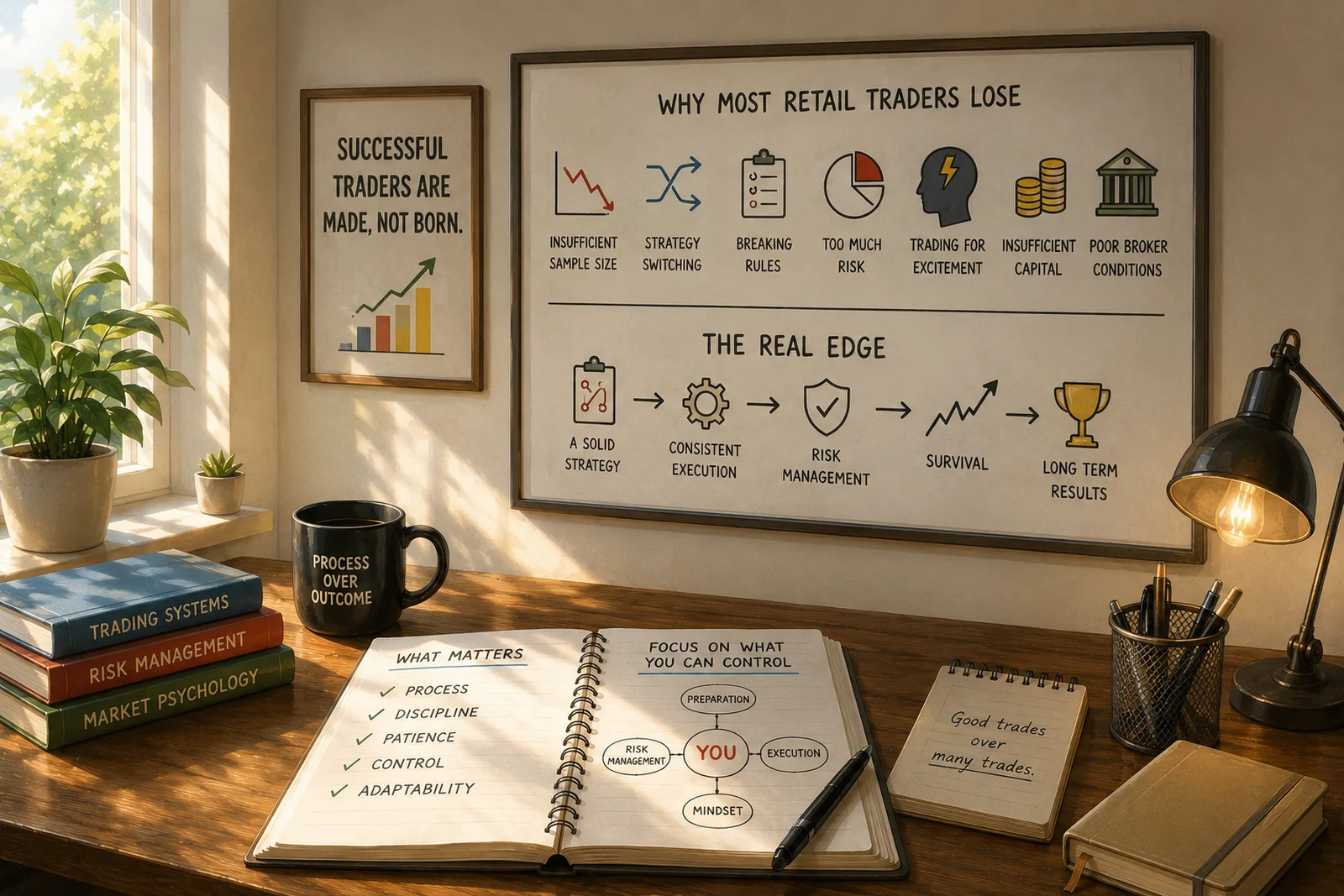
These 11 rules hang on my wall above my monitors so I always have them in sight - especially in those moments when I’m rushing to do something silly.
Want some homework? Put together your own handful of rules. Start with one, maybe two, that you can actually follow. And gradually add more.
Happy trading...