
Introduction
Pretty much all of us have done this at least once. Somewhere we saw a trading signal - from a friend, in a Telegram group, on Discord, or from some „guru“ on YouTube. Somebody told us: „Go long on gold at 2,350, stop at 2,340, target 2,380.“ So we did. And when it worked, we told ourselves - „great, I’ll follow more signals.“ And when it didn’t? „Oh well, the next one will work.“
Another example. We meet a successful trader and ask him: „What’s your strategy? Could you share it with me?“ Some of them actually will. And we walk away with the feeling that we’re holding the holy grail.
Except a few weeks or months later, we find out that the exact same strategy somehow doesn’t work for us the way it worked for him. And here’s the most important question of this whole article:
Why do two people with the same rules end up with completely different results?
We don’t need to speculate about this. There is a historically documented experiment that answers it.
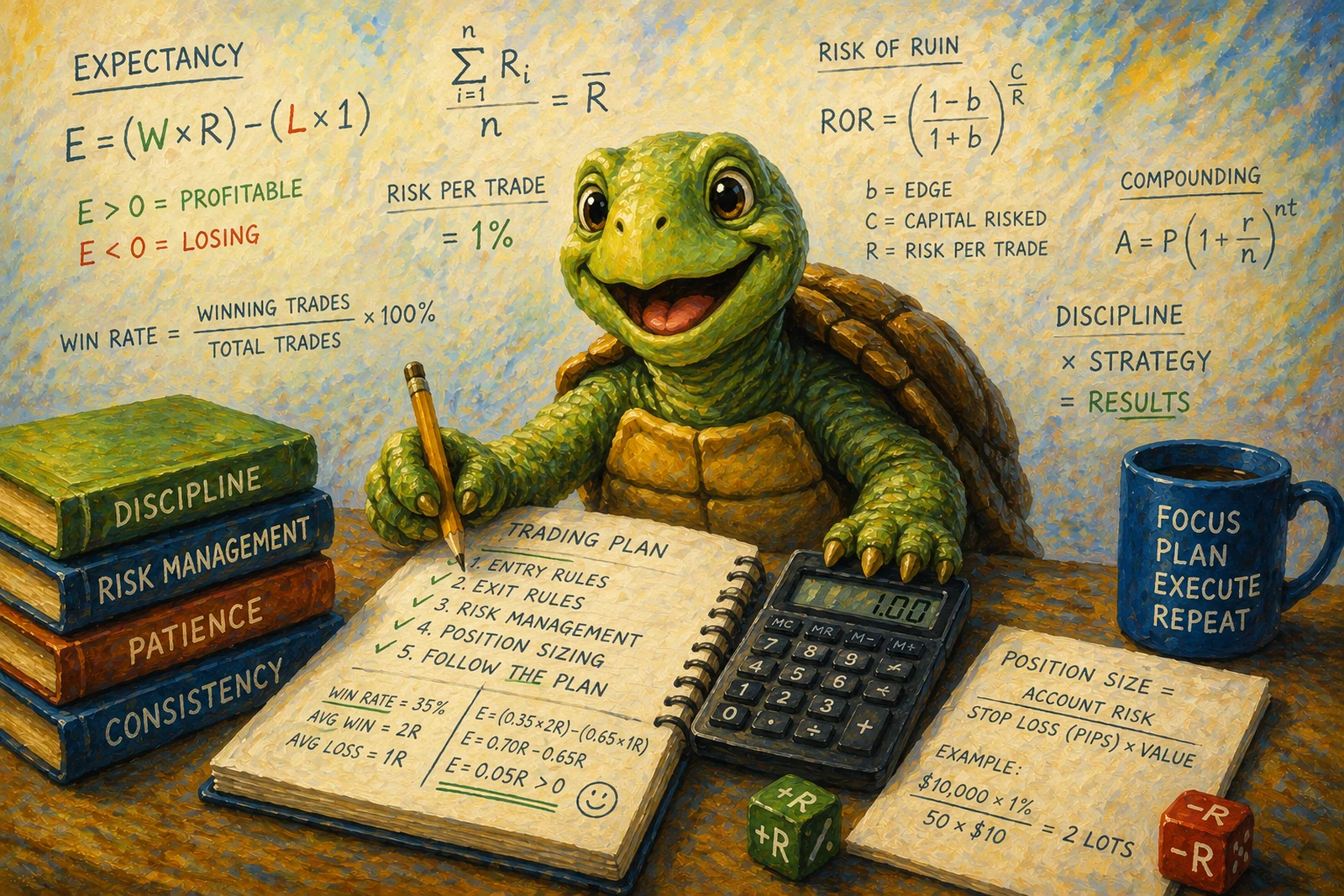
Turtle Traders - 13 People, One Strategy
In 1983, two legendary commodity traders - Richard Dennis and William Eckhardt - had a heated argument. Dennis claimed that a successful trader can be trained - you just need to teach them the rules and the discipline. Eckhardt argued the opposite: a trader is born, it’s an innate talent.
To settle the dispute, they made a bet. Dennis placed an ad in the Wall Street Journal and picked a group of ordinary people with zero trading experience - teachers, musicians, engineers. He named them the Turtles, after a turtle farm in Singapore where turtles are bred industrially.
He gave these people:
- two weeks of training,
- the same strategy (a trend-following system based on 20- and 55-day breakouts),
- the same rules for position sizing, stop-losses and money management,
- real money to trade with (anywhere from $500,000 to $2 million per account).
As a group, they made more than $175 million over the next few years. Dennis won the bet - he proved that trading can be taught.
But here’s the interesting detail this whole article is built on:
Even though they all received the exact same rules, their results were dramatically different. Some Turtles made huge amounts of money and later became successful fund managers (Jerry Parker being a well-known example). Others got just average results. And some - despite being handed the same system - failed completely. They either couldn’t follow the rules, or they dropped out of the experiment.
And now the key question: How is it possible that the same people, trained by the same mentors, using the same strategy, ended up with such different results?
The answer is simple - and at the same time very uncomfortable for anyone hunting for the holy grail in someone else’s strategy:
The strategy was the same for everyone. The people were different.
Why We Are Different - and Why It Matters in Trading
A strategy is just a skeleton. Really, it’s just a set of rules written on paper. But behind every click on Buy or Sell there is a specific human being. And that human being has:
- a different psychological tolerance for losses,
- a different amount of capital - and therefore a different real-life weight of a single trade,
- a different patience to sit through ten losing trades in a row,
- a different ability to sit in profit without closing too early,
- a different life context (family, work, health, stress),
- different life experience with money and risk,
- different expectations of the market and of themselves.
The trend-following strategy the Turtles received had a win rate of around 35-40%. Which means six out of ten trades were losers. Now imagine you have ten losing trades in a row. And now imagine you’re sitting in front of the eleventh - the one that could be the big winner that pays for all the previous losses.
Which of these people can enter that eleventh trade with the same ease they had entering the first? Some can. Some can’t. And that’s exactly the point where it was decided which Turtles would make millions and which would wash out.
Someone Else’s Trading Signal - Why It’s Not the Answer
Let’s go back to that Telegram signal. When you follow someone else’s signal, you get only the entry price, the stop-loss and the target. That’s it. But what do you not get?
- You don’t get the context - why the trade was opened.
- You don’t get the psychology of the person who opened it - their calm, their experience, their ability to sit through a drawdown.
- You don’t get their money management - you don’t know what slice of capital they risked, versus what slice you’re risking.
- You don’t get their plan B for when the market does something unexpected.
- You don’t get the rest of their strategy - their next 99 trades, which together form the overall picture.
And most importantly - you don’t get the most critical thing of all: trust in the signal, which comes only from knowing the system deeply and understanding why it works. When the drawdown comes - and it will come - you have nothing to lean on. Someone else’s signal carries you only as long as it’s in profit. The moment it goes red, you start to panic, because it isn’t yours.
This is the psychological difference between your own setup and someone else’s signal. You trust your own setup because you know why you took it. Someone else’s signal you took on faith - and faith via a screen at -5% drawdown is not enough.
Why Asking Someone for Their Strategy Doesn’t Make Sense
For the same reason it doesn’t make sense to ask a skinny friend for his diet plan. Sure, he can give it to you. But he goes running twice a day, you don’t. He’s 30, you’re 50. He has a different metabolism, different sleep, a different job, different eating habits from childhood.
The same applies in trading. If somebody tells you „I trade 4H breakouts on the DAX,“ you got a sliver of his strategy. You didn’t get:
- his risk tolerance (does he risk 0.5% or 2% per trade?),
- his filters (when does the strategy not trade?),
- his capital (can he afford to sit through a drawdown?),
- his patience (does he wait weeks for the right setup?),
- his daily routine (does he sit at the charts all day or does he use alerts?),
- his emotional routine after a losing trade,
- and most importantly - the thousands of hours of backtesting and screen time that brought him to the point of trusting the system.
Even if he handed you the complete rules in every last detail, you would still trade his strategy differently than he does. Because you are you, and he is he. Exactly like the Turtles.
When Following Someone’s Signals Does Make Sense
To not be completely black-and-white about this - there are a few situations where following someone else’s signals can have some value:
1. As a learning tool. Watching an experienced trader’s trades along with their commentary on why they took them can be valuable. You see the logic, you learn to recognize setups. But it’s about studying, not blind copying.
2. With copy trading that has full transparency. If you’re using a platform where you can see the trader’s full history, drawdowns, money management - and you’re prepared to ride out their drawdowns without switching off copying at the worst possible moment - that can be a legitimate investment approach. But then it’s more of an investment than trading.
3. When it serves as a second opinion on your own setup. If the signal confirms what you’re seeing yourself, it can act as an additional confirming factor. But the decision still has to be yours.
In all other cases - „I’ll buy signals and I’ll make money“ - it’s a road to a blown account. Not because the signals are bad. But because you are not the one who came up with them.
What Actually Works
What actually works is not looking for someone else’s strategy. It’s building your own - one that fits you:
- Your capital.
- Your time.
- Your psychology.
- Your risk tolerance.
- Your patience.
- Your lifestyle.
Get inspired by other people’s strategies - absolutely, yes. Read, study, observe. But then pick out what makes sense to you. Test it. Backtest it. Try it first on a demo account or with micro-positions. Adjust it. And then - and this is the hardest part - stick with it long enough to actually know whether it works.
The Turtles worked not because the strategy was a stroke of genius (it was simple - breakouts on 20- and 55-day highs/lows, something anyone can describe today). It worked because those who stayed with it and trusted it through losing streaks became wealthy.
Conclusion
Following someone else’s signals and strategies is attractive because it promises a shortcut. Somebody figured out the system for you - you just copy it. But the market doesn’t like shortcuts. The market tests people, not systems.
Strategy is 20% of success. The ability to stick to that strategy - even when it’s going against you, even when you’re in drawdown, even when your head is whispering „this time it’s different“ - that is the remaining 80%.
And you will never get that 80% from anyone else. Not in a Telegram group, not in a book, not from a mentor. That 80% you have to build yourself. Years of trading, thousands of setups, hundreds of mistakes. Only then does a strategy start to mean something - because it’s yours.
Just like with the Turtles. The same mentors, the same strategy, the same rules - and dramatically different outcomes. Because at the end of the day, what you trade is not the deciding factor.
What matters is who is doing the trading. And that is always you.